BEoRN: Modelling the 21-cm Signal by post-processing 21cmFAST density (LPT) and haloes (CHMF)#
This notebook demonstrates how to use BEoRN to model the 21-cm brightness temperature signal from the Epoch of Reionization (EoR). BEoRN paints astrophysical radiation fields — X-ray heating, Lyman-alpha coupling, and ionization — onto a cosmological density field by placing pre-computed 1D profiles around dark matter halos.
The density fields and halo catalogs are generated here using py21cmfast, a semi-numerical simulation code for the EoR. BEoRN then uses these as input to produce full 3D maps of the 21-cm signal.
Requirements: Install BEoRN with the optional dependencies (py21cmfast and hmf):
pip install "git+https://github.com/cosmic-reionization/beorn.git[extra]"
Output: All results are saved under ./output/ and intermediate cached computations under ./cache/. Both directories are created automatically.
import numpy as np
from pathlib import Path
import matplotlib.pyplot as plt
import matplotlib.gridspec as gridspec
%matplotlib inline

import logging
logging.basicConfig(level=logging.INFO)
logger = logging.getLogger(__name__)
FILE_ROOT = Path(".")
CACHE_ROOT = FILE_ROOT / "cache"
OUTPUT_ROOT = FILE_ROOT / "output"
import beorn

import matplotlib as mpl
mpl.rcParams.update({
    'font.size': 14,
    'axes.labelsize': 14,
    'xtick.labelsize': 12,
    'ytick.labelsize': 12,
    'legend.fontsize': 12,
    'axes.titlesize': 14,
})
INFO:numexpr.utils:NumExpr defaulting to 10 threads.
1. Set simulation and astrophysical parameters#
Here we define the cosmology, the simulation volume, and the astrophysical source model.
Simulation grid (
simulation): box size and grid resolution determine the spatial dynamic range.Cosmo-sim inputs (
cosmo_sim): settings specific to py21cmfast — internal resolution factor, random seed, and the snapshot redshifts at which py21cmfast is run and BEoRN paints the signal.Solver (
solver): the high-resolution redshift grid over which the 1D RT profiles are integrated, and the halo mass and accretion-rate bins that define the profile lookup table. More profile redshift steps → more accurate bubble growth integration. The snapshot grid can be coarser — BEoRN matches each snapshot to the nearest profile redshift.Cosmology (
cosmology): standard ΛCDM parameters. Must be consistent with the py21cmfast run.Source model (
source): star formation efficiency, ionizing photon production, X-ray emission, and Lyman-alpha flux. These are the key parameters to vary when exploring different reionization histories.
Tip: Start with a coarse grid (
Ncell=64) for quick exploration, then increase resolution for production runs.
parameters = beorn.structs.Parameters()

## Simulation grid
parameters.simulation.cores = 4
parameters.simulation.Lbox  = 100       # comoving Mpc/h
parameters.simulation.Ncell = 128

## Cosmo-sim inputs (py21cmfast-specific)
py21cmfast_high_res_factor = 3
parameters.cosmo_sim.random_seed = 12345
parameters.cosmo_sim.snapshot_redshifts = np.arange(20, 5, -0.50)    # coarser snapshot grid

## Solver: profile redshift grid and halo mass/accretion bins
parameters.solver.redshifts                = np.arange(20, 5, -0.25) # fine profile grid
parameters.solver.halo_mass_bin_min        = 1e7
parameters.solver.halo_mass_bin_max        = 1e15
parameters.solver.halo_mass_nbin           = 40
parameters.solver.halo_mass_accretion_alpha = np.array([0.785, 0.795])

# Source age: how far back to integrate the emission history.
# z_source_start: no sources before this redshift (replaces hardcoded z=35).
# t_source_age: cap the lookback to this many Myr (None = use z_source_start only).
parameters.solver.z_source_start  = 35.0  # default
parameters.source.t_source_age    = None  # default (no age cap)

## Cosmology
parameters.cosmology.Om = 0.315
parameters.cosmology.Ob = 0.049
parameters.cosmology.Ol = 1-0.315
parameters.cosmology.h0  = 0.673

## Source parameters
# X-ray emission
parameters.source.energy_cutoff_min_xray = 500
parameters.source.energy_cutoff_max_xray = 10000
parameters.source.energy_min_sed_xray = 200
parameters.source.energy_max_sed_xray = 10000
parameters.source.alS_xray = 1.5
parameters.source.xray_normalisation = 0.3 * 3.4e40

# Lyman-alpha
parameters.source.n_lyman_alpha_photons = 9690
parameters.source.lyman_alpha_power_law = 0.0

# Ionization
parameters.source.Nion = 2000

# Escape fraction
parameters.source.f0_esc = 0.2
parameters.source.pl_esc = 0.5

# Star formation efficiency
parameters.source.f_st = 0.2
parameters.source.g1 = 0.49
parameters.source.g2 = -0.61
parameters.source.g3 = 4
parameters.source.g4 = -4
parameters.source.Mp = 1.6e11 * parameters.cosmology.h0
parameters.source.Mt = 1e9

# Minimum star-forming halo mass
parameters.source.halo_mass_min = 1e8
Source model visualization#
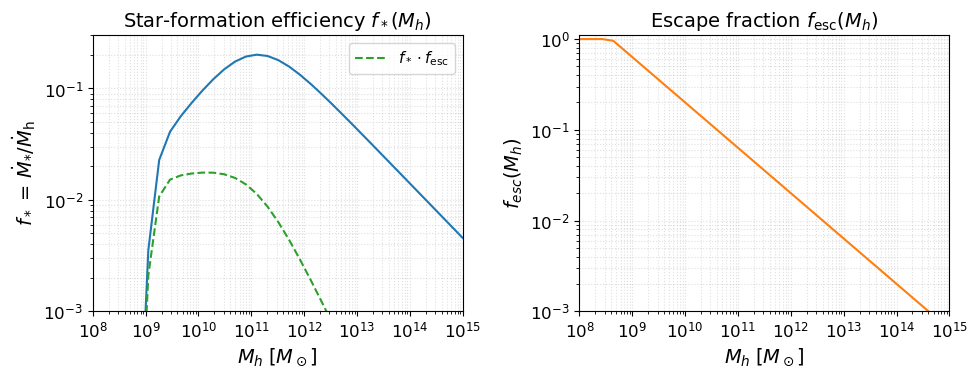
Before running anything, it is useful to inspect the astrophysical source model implied by the parameters above. The two key efficiency functions are:
Star-formation efficiency $f_*(M_h)$: fraction of accreted baryons converted into stars (double power-law with a low-mass suppression below $M_t$).
Escape fraction $f_\mathrm{esc}(M_h)$: fraction of ionising photons that escape into the IGM (power-law in halo mass).
These two functions, multiplied together and by $N_\mathrm{ion}$, set the ionising emissivity of each halo.
fig, axes = plt.subplots(1, 2, figsize=(10, 4))

beorn.plotting.draw_star_formation_rate(axes[0], parameters, color='C0')
beorn.plotting.draw_f_esc(axes[1], parameters, color='C1')

# Overlay f_star * f_esc on the left panel to show the combined ionising efficiency
Mh_grid = parameters.solver.halo_mass_bins
keep = (Mh_grid > parameters.source.halo_mass_min) & (Mh_grid <= parameters.source.halo_mass_max)
Mh_plot = Mh_grid[keep]
from beorn.astro import f_star_Halo, f_esc as f_esc_func
combined = f_star_Halo(parameters, Mh_plot) * f_esc_func(parameters, Mh_plot)
axes[0].loglog(Mh_plot, combined, color='C2', ls='--', label=r'$f_* \cdot f_\mathrm{esc}$')
axes[0].legend(fontsize=11)

axes[0].set_title(r'Star-formation efficiency $f_*(M_h)$')
axes[1].set_title(r'Escape fraction $f_\mathrm{esc}(M_h)$')

for ax in axes:
    ax.set_xlabel(r'$M_h \; [M_\odot]$')
    ax.grid(True, which='both', ls=':', alpha=0.4)
    ax.set_xlim(1e8,1e15)
axes[0].set_ylim(1e-3,3e-1)
axes[1].set_ylim(1e-3,1.1)

plt.tight_layout()
plt.show()
2. Precompute radiation profiles#
BEoRN pre-computes 1D radial profiles of X-ray heating, Lyman-alpha flux, and ionization around halos of different masses. These profiles capture how radiation from the first galaxies affects the surrounding IGM as a function of distance. Pre-computing them once and caching the result means they can be reused efficiently when painting different realisations or astrophysical models.
Note: This step depends only on the astrophysical parameters above — it does not require the cosmological density field or halo catalogs generated in the next section.
cache_handler = beorn.io.Handler(CACHE_ROOT)

solver = beorn.precomputation.RadiationProfileSolver(
    parameters, parameters.cosmo_sim.snapshot_redshifts
)
profiles = solver.get_or_compute_profiles(cache_handler)
INFO:beorn.io.handler:Using persistence directory at cache
INFO:beorn.precomputation.solver:Loaded radiation profiles from cache (z=20.00→5.50, 30 steps).
Inspecting the pre-computed 1D profiles#
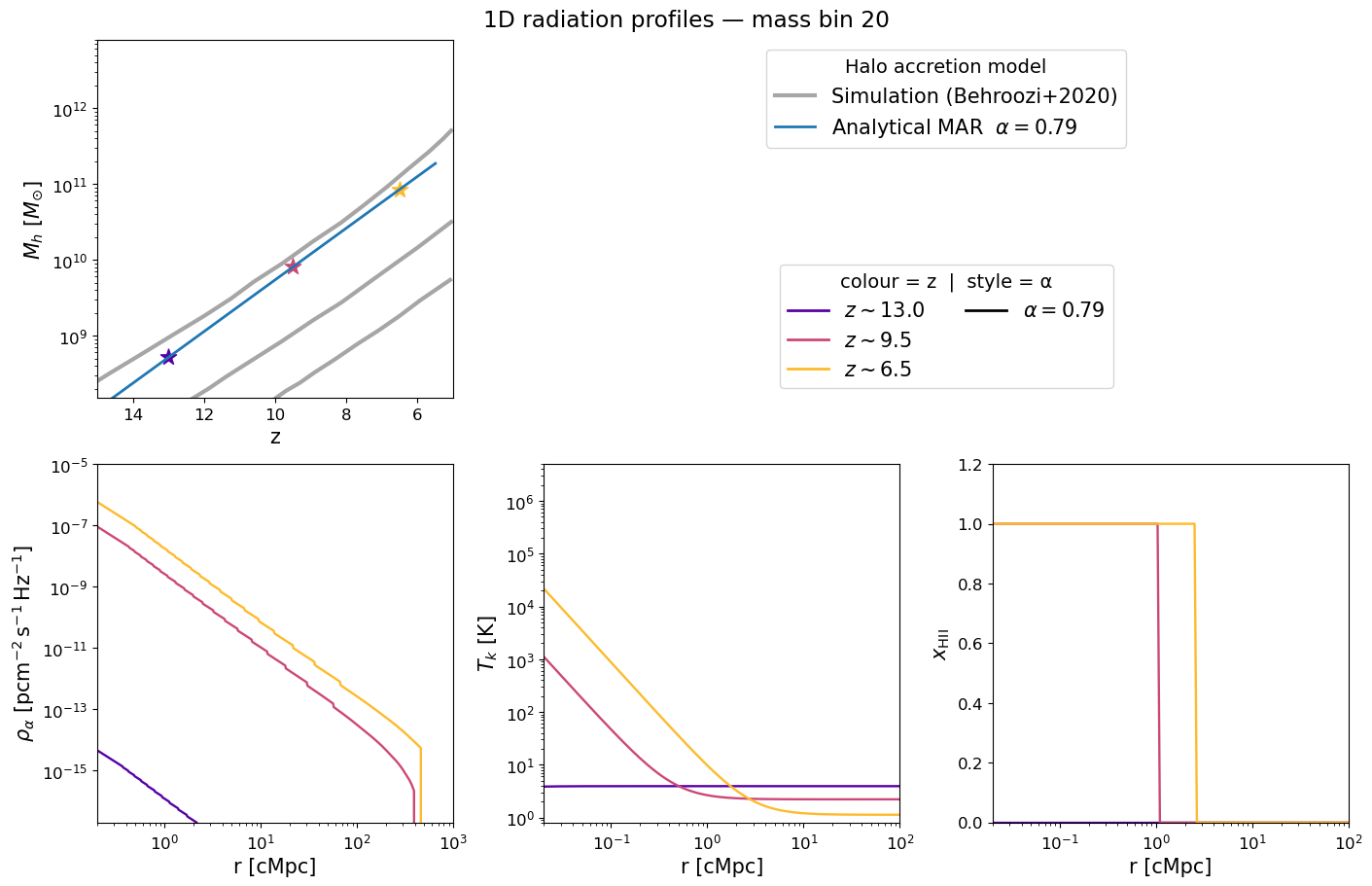
The figure below mirrors Figure 2 of Schaeffer et al. 2023. Each panel corresponds to a different halo mass and shows how the radial profile evolves with redshift (blue → red):
Halo mass accretion history — exponential MAR model (grey) vs. Behroozi et al. 2020 simulations (gold).
Lyman-α flux profile $\rho_\alpha(r)$ — sets the WF coupling $x_\alpha$.
Kinetic temperature profile $T_k(r)$ — driven by X-ray heating.
Ionization fraction $x_\mathrm{HII}(r)$ — sharp bubble front expanding with time.
Adjust mass_index and the redshift/alpha lists to explore different halo masses or accretion histories.
# Select a mid-range mass bin and three representative redshifts
# (matching roughly the three panels of Fig. 2 in arXiv:2305.15466)
mass_index = 20   # index into the 40-bin halo mass grid (~10^10–10^11 Msol depending on z)
profile_redshifts = [13.0, 9.5, 6.5]
# Use only the first alpha value to match the number of alpha bins in the cached profiles
profile_alphas = [parameters.solver.halo_mass_accretion_alpha[0]]

beorn.plotting.plot_1D_profiles(
    parameters,
    profiles,
    mass_index=mass_index,
    redshifts=profile_redshifts,
    alphas=profile_alphas,
    label=f"1D radiation profiles — mass bin {mass_index}",
    fontsize=15,
)
3. Generate the cosmological density field and halo catalogs#
We use py21cmfast to produce the raw cosmological inputs: matter density fields and dark matter halo catalogs at each redshift. These encode where and how massive the first collapsed structures are — the seeds of the first galaxies.
This step only needs to run once for a given cosmology, box size, and random seed. If the data already exists from a previous run it will be reused automatically, so you can safely re-run this cell.
loader = beorn.load_input_data.Py21cmFastLoader(parameters, high_res_factor=py21cmfast_high_res_factor)
output_handler = beorn.io.Handler(OUTPUT_ROOT, input_tag=loader.input_tag)

loader.generate(output_handler)
INFO:beorn.io.handler:Using persistence directory at output
INFO:beorn.load_input_data.cosmo_sim_py21cmfast:py21cmfast setup:
  Output directory : output/py21cmfast_N128_D384_L100_seed12345_afc10c94
  Grid             : HII_DIM=128, DIM=384 (factor 3x)
  Box size         : 100.0 Mpc/h (148.6 Mpc)
  Threads          : 4
  Random seed      : 12345
  Cosmology        : Om=0.315, Ob=0.049, h=0.673, sigma_8=0.83, ns=0.96
INFO:beorn.load_input_data.cosmo_sim_py21cmfast:All 30 snapshots already cached. Skipping generation.
4. Inspect the halo catalog and density field#
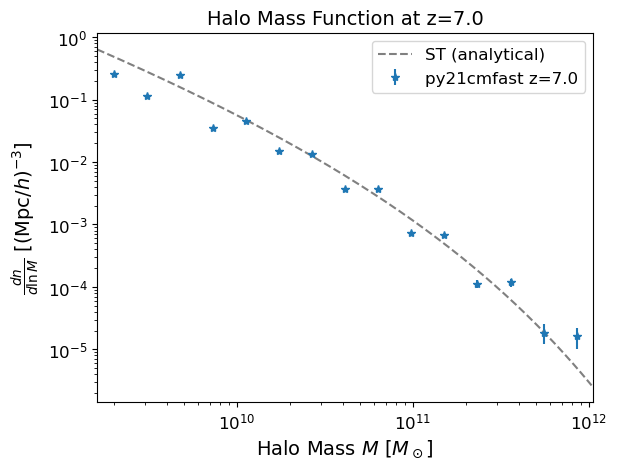
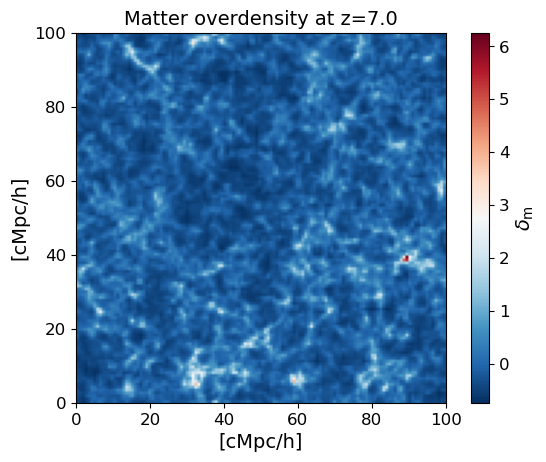
Before running the full simulation, it is useful to check the input data. The halo mass function describes the abundance of dark matter halos as a function of mass and should match the analytical prediction (Sheth & Tormen 1999) for the given cosmology and redshift. We also show a 2D slice through the matter overdensity field, which reveals the large-scale cosmic web structure.
z_target = 7.0
z_index = np.argmin(np.abs(loader.redshifts - z_target))

halo_catalog = loader.load_halo_catalog(z_index)
print(f"Number of halos at z={z_target}: {len(halo_catalog.masses)}")
print(f"Mass range: {halo_catalog.masses.min():.2e} — {halo_catalog.masses.max():.2e} Msol")

# Plot halo mass function from the catalog with analytical Sheth & Tormen (1999) reference
fig, ax = plt.subplots()
beorn.plotting.plot_halo_mass_function(ax, halo_catalog, bin_count=15,
                                       label=f'py21cmfast z={z_target}',
                                       analytical_model='ST')
ax.set_title(f'Halo Mass Function at z={z_target}', fontsize=14)
ax.legend()
plt.show()
INFO:beorn.structs.halo_catalog:No alpha values provided, using default value of 0.79 for all halos.
Number of halos at z=7.0: 320931
Mass range: 1.78e+09 — 9.63e+11 Msol
delta_m = loader.load_density_field(z_index)

Lbox = parameters.simulation.Lbox  # cMpc/h
extent = [0, Lbox, 0, Lbox]

plt.figure()
plt.imshow(delta_m[:, delta_m.shape[1] // 2, :], origin='lower', cmap='RdBu_r', extent=extent)
plt.colorbar(label=r'$\delta_\mathrm{m}$')
plt.xlabel('[cMpc/h]')
plt.ylabel('[cMpc/h]')
plt.title(f'Matter overdensity at z={z_target}')
plt.show()
5. Paint the 3D signal maps#
BEoRN places the pre-computed profiles around each halo in the catalog and accumulates their contributions on the grid. This produces 3D maps of the ionization fraction, gas temperature, and Lyman-alpha coupling at each redshift — the ingredients needed to compute the 21-cm brightness temperature.
Snapshots that have already been computed are skipped automatically, so interrupted runs resume from where they left off.
p = beorn.painting.PaintingCoordinator(
    parameters,
    loader=loader,
    output_handler=output_handler,
)

# paint_full() returns immediately — grid fields are lazy.
# Each field (Grid_xHII, Grid_Temp, …) is backed by per-z HDF5 files;
# a slice is read from disk only when first accessed and then cached.
multi_z_quantities = p.paint_full(profiles)
INFO:beorn.painting.coordinator:============================================================
BEoRN model summary
============================================================
  Cosmology   : Om=0.315, Ob=0.049, h0=0.673, sigma_8=0.83
  Grid        : Ncell=128, Lbox=100 Mpc/h
  Profile z   : z=20.0 -> 5.2 (60 steps)
  Snapshot z  : z=20.0 -> 5.5 (30 snapshots)
  1D RT bins  : 1.0e+07 - 1.0e+15 Msun at z=5.2 (40 bins, traced back via exp. accretion)
  Source      : f_st=0.2, Nion=2000, f0_esc=0.2
  X-ray       : norm=1.02e+40, E=[500, 10000] eV
  Lyman-alpha : n_phot=9690, star-forming above 1.0e+08 Msun
  Beorn hash  : cfdfd1e6
============================================================
INFO:beorn.painting.coordinator:Painting profiles onto grid for 30 of 30 redshift snapshots. Using 4 processes on a single node.
INFO:beorn.painting.coordinator:Found painted output for z=20.000 — skipping (set force_recompute=True to repaint).
INFO:beorn.painting.coordinator:Found painted output for z=19.500 — skipping (set force_recompute=True to repaint).
INFO:beorn.painting.coordinator:Found painted output for z=19.000 — skipping (set force_recompute=True to repaint).
INFO:beorn.painting.coordinator:Found painted output for z=18.500 — skipping (set force_recompute=True to repaint).
INFO:beorn.painting.coordinator:Found painted output for z=18.000 — skipping (set force_recompute=True to repaint).
INFO:beorn.painting.coordinator:Found painted output for z=17.500 — skipping (set force_recompute=True to repaint).
INFO:beorn.painting.coordinator:Found painted output for z=17.000 — skipping (set force_recompute=True to repaint).
INFO:beorn.painting.coordinator:Found painted output for z=16.500 — skipping (set force_recompute=True to repaint).
INFO:beorn.painting.coordinator:Found painted output for z=16.000 — skipping (set force_recompute=True to repaint).
INFO:beorn.painting.coordinator:Found painted output for z=15.500 — skipping (set force_recompute=True to repaint).
INFO:beorn.painting.coordinator:Found painted output for z=15.000 — skipping (set force_recompute=True to repaint).
INFO:beorn.painting.coordinator:Found painted output for z=14.500 — skipping (set force_recompute=True to repaint).
INFO:beorn.painting.coordinator:Found painted output for z=14.000 — skipping (set force_recompute=True to repaint).
INFO:beorn.painting.coordinator:Found painted output for z=13.500 — skipping (set force_recompute=True to repaint).
INFO:beorn.painting.coordinator:Found painted output for z=13.000 — skipping (set force_recompute=True to repaint).
INFO:beorn.painting.coordinator:Found painted output for z=12.500 — skipping (set force_recompute=True to repaint).
INFO:beorn.painting.coordinator:Found painted output for z=12.000 — skipping (set force_recompute=True to repaint).
INFO:beorn.painting.coordinator:Found painted output for z=11.500 — skipping (set force_recompute=True to repaint).
INFO:beorn.painting.coordinator:Found painted output for z=11.000 — skipping (set force_recompute=True to repaint).
INFO:beorn.painting.coordinator:Found painted output for z=10.500 — skipping (set force_recompute=True to repaint).
INFO:beorn.painting.coordinator:Found painted output for z=10.000 — skipping (set force_recompute=True to repaint).
INFO:beorn.painting.coordinator:Found painted output for z=9.500 — skipping (set force_recompute=True to repaint).
INFO:beorn.painting.coordinator:Found painted output for z=9.000 — skipping (set force_recompute=True to repaint).
INFO:beorn.painting.coordinator:Found painted output for z=8.500 — skipping (set force_recompute=True to repaint).
INFO:beorn.painting.coordinator:Found painted output for z=8.000 — skipping (set force_recompute=True to repaint).
INFO:beorn.painting.coordinator:Found painted output for z=7.500 — skipping (set force_recompute=True to repaint).
INFO:beorn.painting.coordinator:Found painted output for z=7.000 — skipping (set force_recompute=True to repaint).
INFO:beorn.painting.coordinator:Found painted output for z=6.500 — skipping (set force_recompute=True to repaint).
INFO:beorn.painting.coordinator:Found painted output for z=6.000 — skipping (set force_recompute=True to repaint).
INFO:beorn.painting.coordinator:Found painted output for z=5.500 — skipping (set force_recompute=True to repaint).
INFO:beorn.painting.coordinator:Painting of 30 snapshots done.
INFO:beorn.structs.temporal_cube:Opened 30 snapshots from output/igm_data_py21cmfast_N128_D384_L100_seed12345_afc10c94_cfdfd1e6 (grid data is lazy — slices load on demand).
6. Visualise the 3D maps at a single redshift#
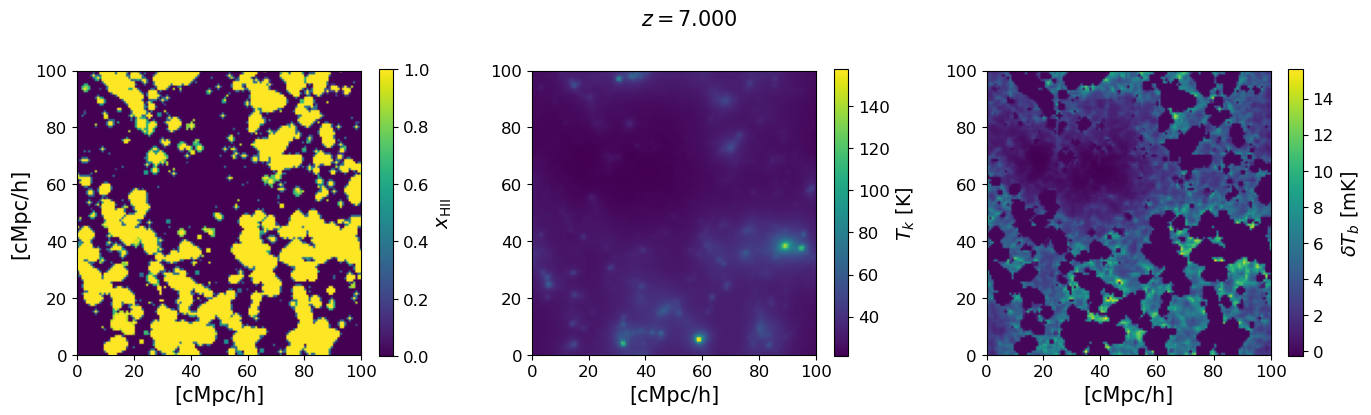
We show a 2D slice through the simulation box for the three key fields at the chosen redshift: the ionization fraction $x_\mathrm{HII}$, the gas kinetic temperature $T_k$, and the 21-cm brightness temperature $\delta T_b$. The ionized bubbles visible in the $x_\mathrm{HII}$ map are driven by the same halos that appear in the mass function above.
# Load only the single snapshot we want to visualise.
# snapshot() accepts a redshift value (nearest match) or an integer index,
# and opens only that one HDF5 file — minimal memory use.
snap = multi_z_quantities.snapshot(z_target)

xHII_grid = snap.Grid_xHII[:]  # 3D array: (Ncell, Ncell, Ncell)
dTb_grid  = snap.Grid_dTb      # derived from this snapshot only
Tk_grid   = snap.Grid_Temp[:]

mid = xHII_grid.shape[1] // 2
Lbox = parameters.simulation.Lbox  # cMpc/h
extent = [0, Lbox, 0, Lbox]

fig, axs = plt.subplots(1, 3, figsize=(14, 4))
for ax, grid, label in zip(axs,
                            [xHII_grid, Tk_grid, dTb_grid],
                            [r'$x_\mathrm{HII}$', r'$T_k$ [K]', r'$\delta T_b$ [mK]']):
    im = ax.imshow(grid[:, mid, :], origin='lower', cmap='viridis', extent=extent)
    ax.set_xlabel('[cMpc/h]', fontsize=15)
    fig.colorbar(im, ax=ax, label=label)
axs[0].set_ylabel('[cMpc/h]', fontsize=15)
fig.suptitle(f'$z={snap.z:.3f}$', fontsize=15)
plt.tight_layout()
plt.show()
7. Global history and power spectra#
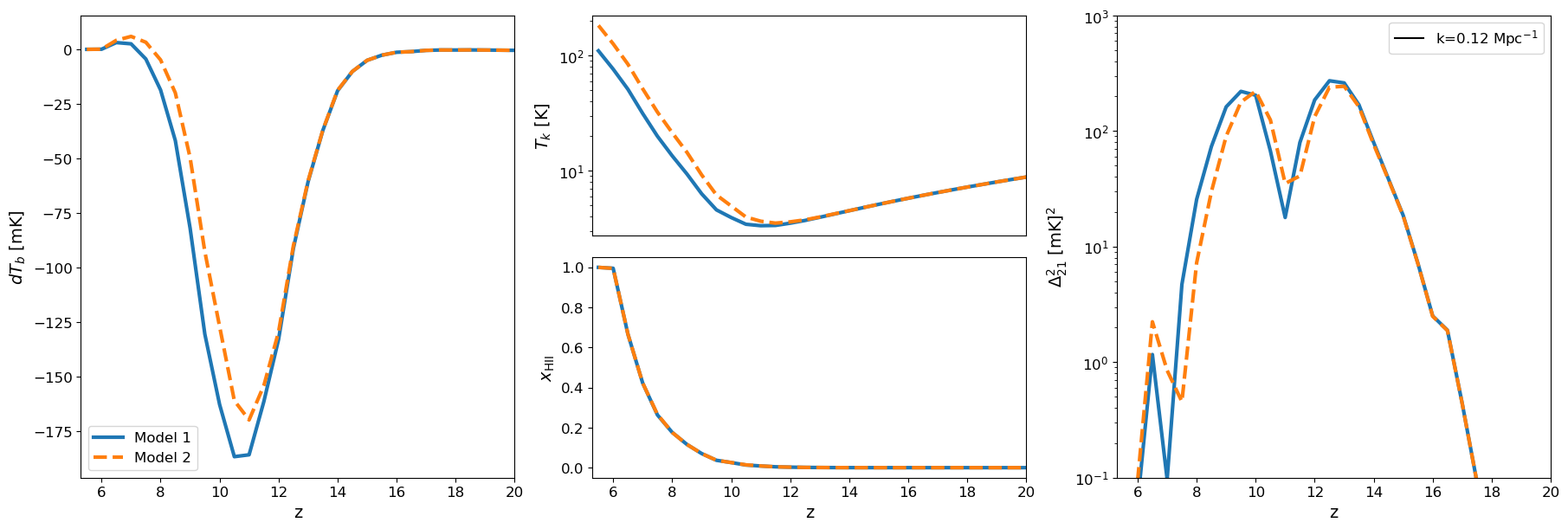
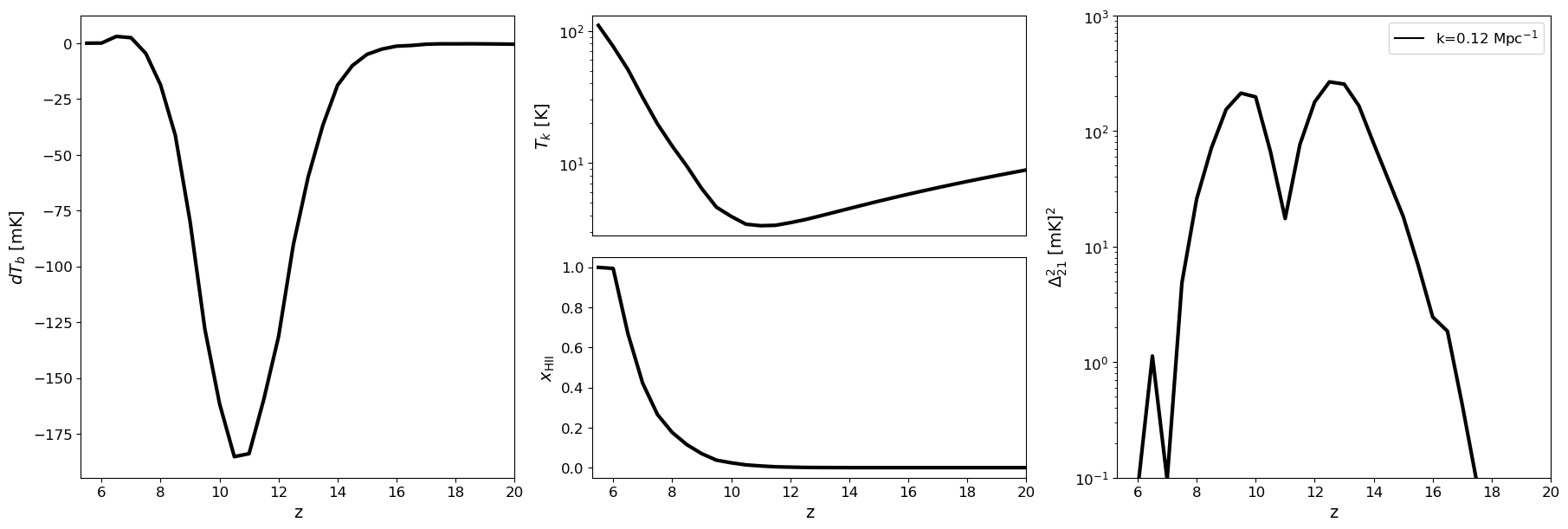
The global (volume-averaged) signal summarises the overall evolution of reionization. We show the redshift evolution of the mean brightness temperature, gas temperature, and ionization fraction, as well as the 21-cm power spectrum amplitude at a fixed wavenumber $k$. These are the primary observational targets of radio telescopes such as SKA, HERA, and MWA.
Memory note: The
draw_*plotting functions useglobal_mean()internally, which iterates snapshots one at a time so peak memory is one 3D grid. The power spectrum panel requiresGrid_dTbacross all $z$ and will load all base fields. For a memory-efficient global signal without the power spectrum, call eachdraw_*function individually.
fig = plt.figure(constrained_layout=True, figsize=(18, 6))
gs = gridspec.GridSpec(2, 3, figure=fig)
ax1 = fig.add_subplot(gs[:, 0])
ax2 = fig.add_subplot(gs[0, 1])
ax3 = fig.add_subplot(gs[1, 1], sharex=ax2)
ax4 = fig.add_subplot(gs[:, 2])

beorn.plotting.draw_dTb_signal(ax1, multi_z_quantities, color='k', lw=3)
beorn.plotting.draw_Temp_signal(ax2, multi_z_quantities, color='k', lw=3)
beorn.plotting.draw_xHII_signal(ax3, multi_z_quantities, color='k', lw=3)
kplot = beorn.plotting.draw_dTb_power_spectrum_of_z(
                    ax4, multi_z_quantities, parameters, k_value=0.1, color='k', lw=3)
ax4.plot([], [], color='k', label=f'k={kplot:.2f} Mpc$^{{-1}}$')
ax4.legend(loc=0)
ax2.axes.get_xaxis().set_visible(False)
plt.show()
k=0.12 Mpc$^{-1}$
Saving and reusing statistics with StatisticsEstimator#
StatisticsEstimator wraps a TemporalCube and computes the same quantities shown above (global means + dimensionless power spectrum), then writes them to an HDF5 file next to the cube directory. On the next run the file is loaded automatically instead of recomputed.
The draw_* plotting functions accept a StatisticsEstimator directly — they read from the cached results instead of touching the large grid arrays.
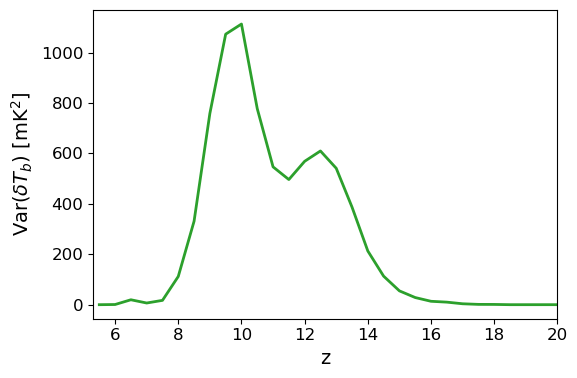
You can add your own estimators by subclassing and appending to _estimators. Here we add the spatial variance of $\delta T_b(z)$ as a simple example.
# --- Custom estimator: add spatial variance of dTb ---
class MyStats(beorn.structs.StatisticsEstimator):
    _estimators = beorn.structs.StatisticsEstimator._estimators + ['variance_signals']

    def variance_signals(self) -> dict:
        """Spatial variance of dTb at each redshift."""
        n_z = len(self.cube.z_snapshots)
        var_dTb = np.empty(n_z)
        for i in range(n_z):
            var_dTb[i] = np.var(self.cube.Grid_dTb[i])
        return {'var_dTb': var_dTb}

# Compute and save to  output/igm_stats_<tag>.h5  (auto-derived from cube path).
# On subsequent runs stats.results loads the file instead of recomputing.
stats = MyStats(multi_z_quantities, parameters)
saved_path = stats.save(path='output/igm_stats_test.h5')          # writes HDF5, caches results in stats._results
print(f"Statistics saved to: {saved_path}")
Statistics saved to: output/igm_stats_test.h5
stats_loaded = beorn.structs.StatisticsEstimator.from_file(
    'output/igm_stats_test.h5'
)

# The draw_* functions accept the StatisticsEstimator directly
fig = plt.figure(constrained_layout=True, figsize=(18, 6))
gs = gridspec.GridSpec(2, 3, figure=fig)
ax1 = fig.add_subplot(gs[:, 0])
ax2 = fig.add_subplot(gs[0, 1])
ax3 = fig.add_subplot(gs[1, 1], sharex=ax2)
ax4 = fig.add_subplot(gs[:, 2])

beorn.plotting.draw_dTb_signal(ax1, stats_loaded, color='k', lw=3)
beorn.plotting.draw_Temp_signal(ax2, stats_loaded, color='k', lw=3)
beorn.plotting.draw_xHII_signal(ax3, stats_loaded, color='k', lw=3)
kplot = beorn.plotting.draw_dTb_power_spectrum_of_z(ax4, stats_loaded, k_value=0.1, color='k', lw=3)
ax4.plot([], [], color='k', label=f'k={kplot:.2f} Mpc$^{{-1}}$')
ax4.legend(loc=0)
ax2.axes.get_xaxis().set_visible(False)

# Also show the variance as an extra panel
fig2, ax_var = plt.subplots(figsize=(6, 4))
r = stats.results
ax_var.plot(r['z'], r['var_dTb'], color='C2', lw=2)
ax_var.set_xlabel('z')
ax_var.set_ylabel(r'$\mathrm{Var}(\delta T_b)$ [mK$^2$]')
ax_var.set_xlim(r['z'].min() - 0.2, r['z'].max())
plt.tight_layout()
plt.show()
k=0.12 Mpc$^{-1}$
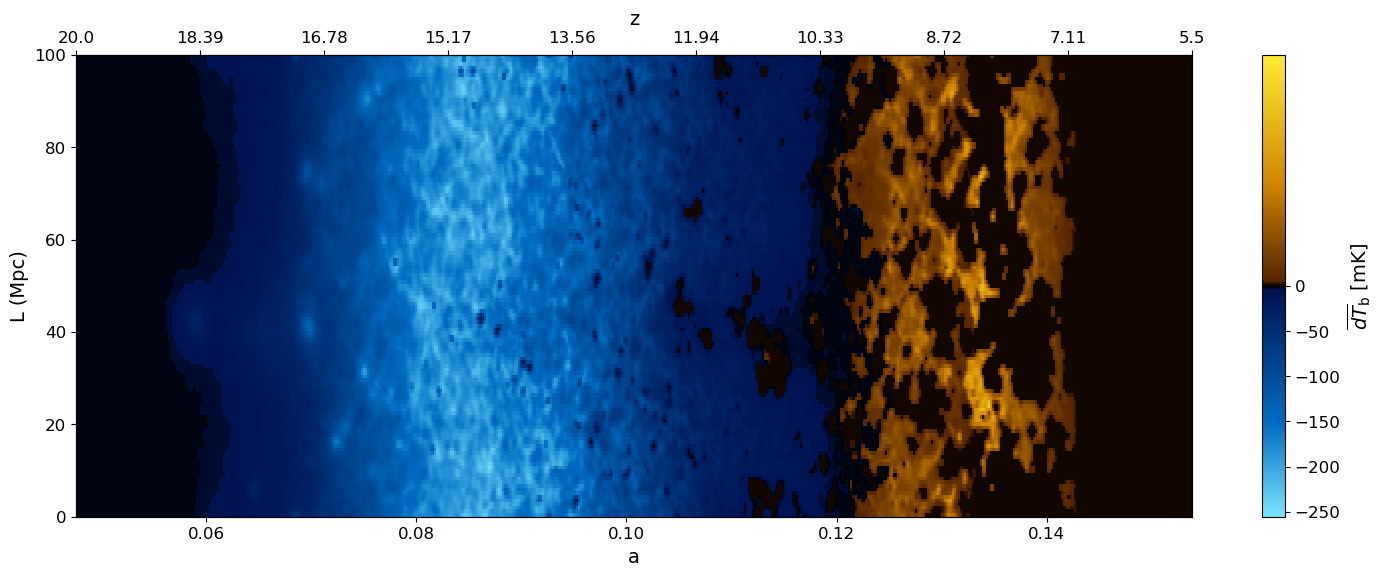
8. Lightcone#
A lightcone stitches together slices from different redshifts to mimic an actual observation: as we observe further into the past, the signal evolves. This is what a radio telescope effectively measures along the line of sight. The horizontal axis shows increasing redshift (earlier cosmic times) from right to left.
lightcone = beorn.structs.Lightcone.build(
    parameters,
    multi_z_quantities,
    quantity="Grid_dTb",
)

fig, ax = plt.subplots(figsize=(18, 6))
beorn.plotting.plot_lightcone(lightcone, ax, "", slice_number=30)
fig.show()
Making lightcone between 0.047619 < z < 0.153845
100%|██████████| 559/559 [00:00<00:00, 4530.13it/s]
...done
9. Compare two runs#
To compare different astrophysical models side-by-side, point IGM_DATA_1 and IGM_DATA_2 at two igm_data_* output directories. BEoRN reads the parameters and grid data directly from those folders — no need to re-specify any parameters manually.
Each TemporalCube.read() call recovers the full Parameters object from the embedded HDF5 metadata, so param1 and param2 automatically reflect the settings used to produce each run.
# Edit these two paths to point at your igm_data_* output directories
IGM_DATA_1 = Path("output/igm_data_py21cmfast_N128_D384_L100_seed12345_4660308f_4024dbb5")
IGM_DATA_2 = Path("output/igm_data_py21cmfast_N128_D384_L100_seed12345_4660308f_457d9d8c")

multi_z_quantities_1 = beorn.structs.TemporalCube.read(IGM_DATA_1)
multi_z_quantities_2 = beorn.structs.TemporalCube.read(IGM_DATA_2)

param1 = multi_z_quantities_1.parameters
param2 = multi_z_quantities_2.parameters
INFO:beorn.structs.temporal_cube:Opened 30 snapshots from output/igm_data_py21cmfast_N128_D384_L100_seed12345_4660308f_4024dbb5 (grid data is lazy — slices load on demand).
INFO:beorn.structs.temporal_cube:Opened 30 snapshots from output/igm_data_py21cmfast_N128_D384_L100_seed12345_4660308f_457d9d8c (grid data is lazy — slices load on demand).
label1 = "Model 1"
label2 = "Model 2"

fig = plt.figure(constrained_layout=True, figsize=(18, 6))
gs = gridspec.GridSpec(2, 3, figure=fig)
ax1 = fig.add_subplot(gs[:, 0])
ax2 = fig.add_subplot(gs[0, 1])
ax3 = fig.add_subplot(gs[1, 1], sharex=ax2)
ax4 = fig.add_subplot(gs[:, 2])

for grid, params, label, color, lstyle in [
    (multi_z_quantities_1, param1, label1, 'C0', '-'),
    (multi_z_quantities_2, param2, label2, 'C1', '--'),
]:
    beorn.plotting.draw_dTb_signal(ax1, grid, label=label, color=color, ls=lstyle, lw=3)
    beorn.plotting.draw_Temp_signal(ax2, grid, label=label, color=color, ls=lstyle, lw=3)
    beorn.plotting.draw_xHII_signal(ax3, grid, label=label, color=color, ls=lstyle, lw=3)
    kplot = beorn.plotting.draw_dTb_power_spectrum_of_z(
                    ax4, grid, params, label=None, k_value=0.1, color=color, ls=lstyle, lw=3)

ax1.legend()
ax4.plot([], [], color='k', label=f'k={kplot:.2f} Mpc$^{{-1}}$')
ax4.legend(loc=0)
ax2.axes.get_xaxis().set_visible(False)
plt.show()
k=0.12 Mpc$^{-1}$
k=0.12 Mpc$^{-1}$